
Reforms are coming.
Your harvest can’t wait for them.
Municipal water reform in South Africa is a multi-year rebuild. Irrigation cycles, packhouse compliance windows and livestock welfare operate on a much shorter clock — which is why serious farms are engineering water independence at the farm boundary.
The National Water Action Plan, in five levers
President Cyril Ramaphosa’s reform programme targets the structural failures behind South Africa’s municipal and bulk water shortfalls. It’s necessary work — and it will take years to land.
Bulk infrastructure spend
Upgrading regional pipelines and treatment capacity.
Legislative reform
Stricter accountability for municipal distribution.
Financial ring-fencing
Water revenues kept inside the utilities that earned them.
Private capital (PPPs)
Mobilising private investment alongside the state.
Emergency rural schemes
Boreholes and package plants for underserved areas.
Four places a supply interruption becomes a loss
Relying only on direct river abstraction or a municipal line leaves an operation exposed at exactly the moments it can least afford it.
Irrigation buffering
Tanks bank water during off-peak pumping or canal availability, holding steady pressure for drip lines and pivots without over-drafting boreholes.
Packhouse compliance
Fruit washing, hydro-cooling and line sanitation need clean, uncontaminated volume on demand — sealed storage protects export food-safety standards.
Livestock welfare
Dairy, feedlot and poultry troughs stay full through multi-day mains outages and heatwaves, protecting herd health and yield.
Spray precision
Clean, pH-balanced water on tap keeps herbicide and pesticide chemistry consistent and turnaround fast in tight pest-control windows.
The Oasis Tanks farm advantage
Modular steel reservoirs engineered specifically for South African farming, from smallholder plots to full commercial estates.
Key technical specifications
Every design choice answers a specific on-farm failure mode — corrosion, contamination, evaporation, or install cost.
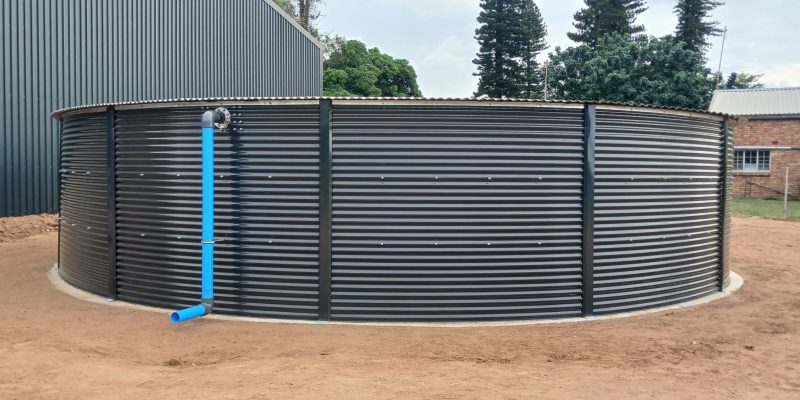
High-tensile corrugated Aluzinc® steel
Engineered to resist severe UV radiation, high winds and temperature swings without warping or rusting.
700gsm food-grade PVC liner
UV-stabilised and heavy-duty, isolating stored water from the steel wall to keep it clean, potable and odourless.
Evaporation-proof domed roof
Sealed steel covers block algae growth, dust and bird droppings while drastically cutting evaporation losses in hot regions.
Economical sand pad base
Tanks under 350,000 litres need only a level, compacted sand pad — no concrete slab, no heavy civil cost.
Mechanical target-board level indicators
High-visibility external gauges let managers read reserves from a distance — no electricity required.
Modular on-site assembly
Flat-packed, precision-drilled panels transport economically to remote farms and assemble on site with minimal disruption.
Agricultural water application matrix
Recommended setups scale with the sector’s water intensity, not a one-size-fits-all tank.
Citrus & Subtropical Orchards
Aluzinc® reservoirs for irrigation buffering & drip supply.
Export Fruit Packhouses
Sealed liner tanks for wash water & line sanitation.
Dairy, Poultry & Livestock
Elevated or ground tanks for troughs & cooling.
Crop Spraying Stations
Fast-fill reservoirs for quick-load spray rig water.
Frequently asked questions
The NWAP aims to reform water boards, upgrade bulk infrastructure and protect water-sector investment over time. Because infrastructure overhauls take years, commercial farmers still need on-farm bulk storage to protect this season’s yield from unexpected supply interruptions.
Steel Aluzinc® tanks reach far larger single-unit capacities (up to 1,000,000+ litres), resist UV better, hold up structurally against livestock impact, and last 40–65+ years without becoming brittle under harsh sun.
Tanks up to 350,000 litres can sit directly on a properly prepared, levelled sand pad, saving thousands of Rands in concrete costs and speeding up installation significantly.
Yes. Fitted with steel dome roofs and gutter connection kits, they can harvest thousands of litres of rainwater from packhouse, workshop and shed roofs, reducing reliance on boreholes.