
With global climate models confirming a high probability of a strong El Niño developing through late 2026 and extending into early 2027, Southern African commercial farming is approaching a critical juncture.
El Niño patterns in the Southern Hemisphere consistently bring extended dry spells, below-average summer rainfall, and elevated ambient temperatures. For citrus, nut, sub-tropical, and crop producers across South Africa—where agriculture accounts for over 60% of available water usage—the difference between a record yield and devastating crop stress comes down to one variable: on-farm water security.
While recent rainfall cycles provided temporary relief, water security is built during the preparation window, not mid-drought. Here is how forward-thinking agribusinesses are future-proofing their irrigation, packhouse operations, and livestock infrastructure.
The Agricultural Threat: Evaporation and Peak-Demand Spikes
When an El Niño event hits, open earth dams lose millions of liters to evaporation daily as heat indices rise. Concurrently, crop evapotranspiration accelerates, requiring precise, high-volume irrigation right when municipal supply lines and river flows face maximum restriction.
Relying solely on open dams or small-scale plastic tanks creates severe operational bottlenecks:
- Severe Evaporation Losses: Uncovered water storage drops in volume precisely when needed most.
- Thermal Degradation: Small plastic tanks heat up rapidly under direct sun and degrade under intense UV exposure, risking structural fatigue over time.
- Water Quality Risks: Stagnant, open, or unsealed water bodies encourage algae growth and contamination, compromising water quality for sensitive irrigation systems and livestock biosecurity.
The Solution: Decentralized, High-Capacity Bulk Steel Storage
To insulate high-value crops (such as macadamias, citrus, and avocados) and intensive livestock operations from climate variability, modern agribusinesses are shifting toward high-capacity, decentralized steel panel reservoirs.
Capturing peak rainwater runoff from expansive packhouse or shed roofs transforms an environmental challenge into a free, high-purity operational asset.
Why Commercial Agriculture Chooses Oasis Tanks
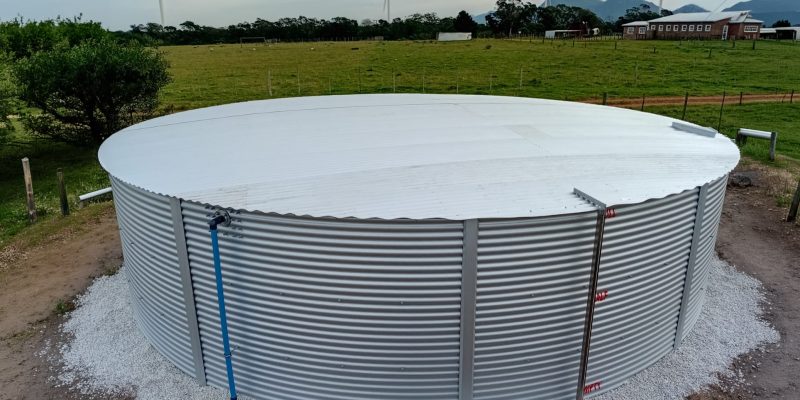
Manufactured by Rainbow Reservoirs, Oasis Tanks are engineered to handle the demands of African farming conditions:
- AZ150 Aluzinc® Steel Technology: Built using premium Aluzinc-coated structural steel, providing up to 3 to 7 times greater corrosion resistance than traditional galvanized coatings, backed by a 40-year expected lifespan.
- Massive Scalability (5,000L to 1,000,000+ Liters): Modular corrugated panels allow custom height-to-diameter ratios tailored precisely to your farm layout and volumetric demands.
- Rapid, Low-Cost Deployment: For tanks under 350,000 liters, no expensive concrete base is required—they assemble quickly on a properly prepared sand pad, drastically cutting civil work costs and lead times.
- Protected Water Quality: Sealed with domed Aluzinc roofs and lined with heavy-duty 700gsm reinforced, food-grade PVC liners, keeping stored water clean, algae-free, and dust-proof.
Invest in Climate Resilience Today
A high-capacity steel water reservoir is more than an emergency backup—it is a core risk-management asset with an average return on investment of 2 to 6 years through protected crop yields and reduced water municipal charges.
Don’t wait for the heatwave to test your farm’s limits.
Prepare your agribusiness for the 2026/2027 season. Contact the Oasis Tanks team today to audit your bulk water needs or request a customized technical quote.