
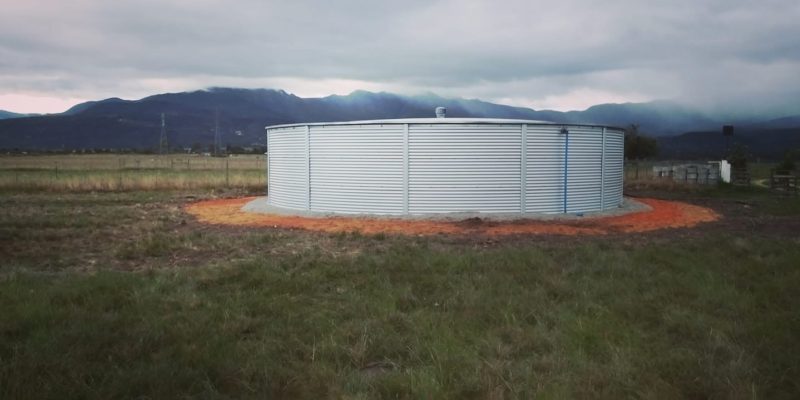
In South African agriculture, water is no longer a seasonal variable—it is a critical, high-stakes business asset. With municipal infrastructure facing unprecedented stability challenges, erratic rainfall cycles, and intensifying peak summer heat, the margin for error in crop irrigation has dropped to zero.
For commercial growers and agribusinesses across South Africa, true water security is no longer about simply having a tank. It is about the scale, structural engineering, and material longevity behind your storage system.
When your crop yields depend on precise, high-volume delivery, traditional small-scale solutions fail to make the grade. Here is how modern modular engineering is changing the landscape of irrigation water storage tanks in South Africa.
1. Material Science: Why Aluzinc® Defeats Traditional Materials
For large-scale irrigation, standard polyethylene (plastic) tanks introduce a massive bottleneck: scale limitation. To store a million litres of water using plastic, you would need to link dozens of individual 10,000-litre tanks, creating an administrative nightmare of complex pipe networks, high failure-point manifolds, and massive footprint requirements.
For bulk water storage, steel is the gold standard. However, not all steel is engineered equally. While old-school hot-dip galvanized tanks have been a farm staple for decades, modern agricultural engineering has evolved.
Oasis Tanks are built using premium AZ150 Aluzinc® steel. This advanced structural steel plate outperforms traditional galvanized coatings by 3 to 7 times in terms of corrosion resistance and environmental durability.
Because irrigation water can carry varying pH levels or mineral contents from boreholes and rivers, the raw structural steel of an Oasis Tank is never in direct contact with your water. Instead, the liquid is securely contained within a 700gsm reinforced PVC liner that is food-grade certified, completely UV-stabilized, and insulated to eliminate light ingress—permanently stopping destructive algal growth before it can clog your micro-drip or pivot nozzles.
2. Structural Comparison: Finding the Right Fit
When assessing high-volume infrastructure investments, evaluating long-term operational metrics side-by-side reveals the true total cost of ownership:
| Feature / Metric | Standard Plastic (Poly) Tanks | Galvanized Steel Tanks | Oasis Aluzinc® Steel Tanks |
| Capacity Limits | Low (typically maxes at 10kL) | High (Bulk modular) | Extreme (9,500L to over 2 Million Litres) |
| Material Lifespan | 10–15 Years (UV degradation) | 15–20 Years (Rust risk) | 40+ Year Expected Lifespan |
| Foundation Needed | Flat, level surface required | Concrete slab mandatory | No concrete required under 349,000L |
| Portability | Fixed or easily damaged | Permanent once bolted | Modular flatpack (Easy to relocate) |
| Maintenance | Low, but prone to cracking | High (Sacrificial anodes/seals) | Virtually Maintenance-Free |
3. The Modular Foundation Advantage
One of the steepest hidden costs of installing a large-scale irrigation reservoir is the civil engineering work. Pouring massive concrete slabs requires heavy machinery, weeks of curing time, and substantial capital expenditure.
Oasis Tanks bypasses this bottleneck entirely for mid-to-high capacity ranges:
The 349,000-Litre Threshold: Any Oasis Tank configuration with a capacity under 349,000 litres can be rapidly installed directly onto a level sand bed ring beam, requiring zero concrete foundations.
Because our systems utilize a precision modular panel design, the entire tank arrives on your farm in a pre-manufactured flatpack kit form. This modular framework delivers three major operational advantages:
- Rapid Installation: Assembly takes days rather than weeks, keeping your farm operations moving forward without disruption.
- Cost-Effective Transport: Flatpack shipping means we can deliver maximum capacity directly to remote agricultural zones across Limpopo, Gauteng, and nationwide with minimal freight friction.
- Future-Proof Agility: If your farm layout changes, crop rotations shift, or you lease new land, an Oasis Tank can be entirely disassembled, transported, and reinstalled at a new location without losing your structural asset.
4. Customizing Your System for Optimal Farm Performance
Every agricultural setup has unique operational demands. To ensure clean, consistent water delivery to your fields, your reservoir infrastructure should be customized to handle the elements.
| Oasis Tank Add-On | Target Function & Benefit |
| Scour/Flush Drain | Optimizes silt out and operational debris removal. |
| Water Level Gauge | Provides real-time capacity monitoring metrics. |
| Wind Turbines / Roofs | Eliminates external light, dust, and vermin ingress. |
5. Securing Long-Term Yield Security
An efficient irrigation system is only as reliable as the source feeding it. Integrating high-capacity bulk storage into your layout provides an immediate buffer against unexpected operational variables:
- Borehole Yield Balancing: Avoid burning out deep-well submersible pumps by allowing them to fill a low-pressure bulk reservoir continuously at a steady flow rate, using high-volume booster pumps to run your irrigation lines only when needed.
- Peak Demand Management: Pump and store water during off-peak electricity hours to dramatically lower your monthly energy overheads.
- Load-Shedding & Infrastructure Insurance: When power grids fluctuate or water allocations face delivery cuts, a 1-million-litre reserve guarantees your high-value crops receive consistent watering schedules exactly when they need it most.
Backed by a comprehensive warranty and engineered for a 40-year operational lifespan, investing in an Oasis Aluzinc® steel reservoir shifts your irrigation model from a daily risk to a highly controlled, predictable business system.
Secure Your Agricultural Water Asset
Don’t let infrastructure bottlenecks dictate your yield capacity. Contact our engineering team today to customize a modular, high-capacity storage layout tailored precisely to your farm’s irrigation layout and terrain constraints.