
Industrial, commercial, and agricultural operations across South Africa share a critical priority: securing a reliable, uninterrupted water supply. However, implementing high-capacity bulk liquid storage frequently introduces a major spatial bottleneck. Traditional concrete reservoirs or massive, single-piece plastic structures demand expansive footprints, heavy machinery access, and substantial structural clearances—luxuries that dense factory complexes, existing commercial yards, and retrofitted industrial facilities simply do not have.
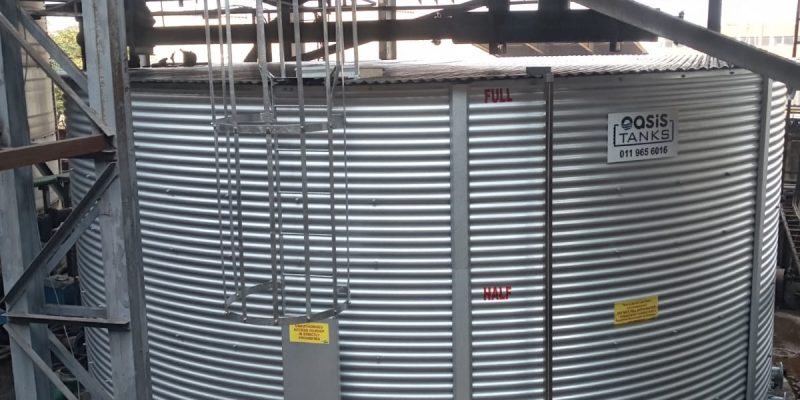
The provided installation photograph highlights a highly engineered solution to this exact architectural constraint. It captures an Oasis Aluzinc Steel Tank successfully erected directly beneath a heavy industrial steel gantry, surrounded by structural columns, piping overhead, and tight horizontal boundaries.
This case study breaks down how the engineering behind Oasis Tanks utilizes advanced materials and modular construction principles to solve severe spatial challenges while delivering institutional-grade liquid containment.
The Spatial Dilemma: Engineering Around Existing Infrastructure
When retrofitting bulk water storage—whether for industrial process water, backup municipal reserves, or dedicated fire suppression systems—facilities are often forced to use leftover, irregular, or heavily compromised spaces.
The installation in the image demonstrates a textbook example of restricted-access positioning:
- Vertical Headroom Constraints: The tank is installed directly underneath an active industrial platform and structural steel frameworks.
- Horizontal Clearance Limits: The perimeter sits centimeters away from structural support pillars, eliminating the possibility of using crane-dropped or prefabricated monolithic structures.
- Complex Structural Footprints: The circular footprint is neatly integrated into an existing concrete slab, maximizing volumetric capacity without altering the surrounding architectural layout.
Traditional construction methodologies fail under these parameters. Pouring a concrete reservoir in such a tight space requires extensive formwork, high labor overhead, and weeks of curing time during which operations must be halted. Conversely, trying to maneuver a pre-molded tank into this footprint is physically impossible without dismantling the overhead structural steel.
Architectural Flexibility via Flat-Pack Modular Engineering
Oasis Tanks—manufactured by renowned Rainbow Reservoirs —overcomes these spatial constraints through a precision-engineered, flat-pack modular design.
Instead of transporting a massive, hollow volume, the entire tank is delivered to the site as a consolidated kit of pre-fabricated, high-tensile structural steel panels. This modular framework fundamentally changes how industrial water security is deployed:
- Flawless Point-of-Access Logistics: Because the components are delivered in a knocked-down kit form, they can be manually carried through standard doorways, down narrow alleys, or between tight structural columns. No heavy rigging, cranes, or wide-clearance access roads are required.
- On-Site Bolted Assembly: The individual structural steel sheets are precision-punched, curved, and profiled using high-tech machinery at the factory. On-site, installation teams assemble the tank panel by panel, bolting them together from the ground up. This allows the tank to literally be built within its final resting place, even inside tight enclosures or directly beneath low-hanging beams.
- Rapid, Non-Disruptive Deployment: By eliminating heavy welding and specialized machinery, a premium modular steel tank can be completely erected and operational within days (depending on capacity), drastically reducing operational downtime.
- No Concrete Required (Up to 350,000L): For capacities under 350,000 liters, Oasis engineering eliminates the need for expensive concrete foundations entirely. The tanks are installed directly onto a professionally leveled sand pad with a sieved plaster sand base and a 19mm aggregate erosion border. This flexible foundation handles natural earth movements without cracking, further simplifying installation in tightly constrained yards.
Material Engineering: The Power of Aluzinc Steel (AZ150)
Beyond spatial adaptability, bulk water containment must withstand severe environmental and mechanical stress. Oasis Water Tanks are built using high-grade AZ150 Aluzinc coated steel, an advanced structural material engineered to deliver a lifespan exceeding 40 years.
What is Aluzinc?
Aluzinc is an exceptionally durable structural steel that is hot-dipped in a specialized alloy composition consisting of:
- 55% Aluminium: Provides an impenetrable physical barrier against atmospheric corrosion and outstanding thermal reflectivity.
- 43.4% Zinc: Offers sacrificial galvanic protection, defending the steel base even at cut edges or drilled bolt holes.
- 1.6% Silicon: Ensures a highly uniform, ultra-adherent alloy bond during the coating process.
This composition prevents the atmospheric rust and structural degradation common to standard galvanized steel tanks, making it ideally suited for the harsh, corrosive environments of South African industrial and mining sectors.
Complete Containment Isolation
As seen in the installation photo, the structural Aluzinc outer shell serves purely to handle the high hydrostatic pressures of the stored liquid. The actual water containment is managed internally by a 700gsm heavy-duty, food-grade reinforced PVC liner.
This liner prevents the stored liquid from ever coming into direct contact with the steel walls. By completely isolating the water, internal corrosion is eliminated, and the water remains 100% potable, leak-proof, and free from contamination—fully satisfying the strict health, safety, and fire protection agency standards across South Africa.
Visual Breakdown of the On-Site Installation
The real-world application pictured displays several highly practical features engineered into every Oasis industrial setup:
- Integrated External Cat-Ladder & Safety Cage: Even when restricted by low overhead clearance, a robust, galvanized safety cage and cat-ladder are integrated into the tank framework, allowing safe, compliant vertical access for maintenance inspections.
- Mechanical Level Indicators: High-visibility, physical target-board level indicators (Full / Half / Empty) are mounted clearly on the tank exterior, providing operators with a zero-power, immediate visual check of current water reserves.
- Heavy-Duty Isolation Valves & Fittings: Industrial-grade inlets, outlets, and drainage valves are positioned cleanly at the base, enabling direct plumbing integration into the plant’s automated fluid networks.
Summary of Specifications: Oasis Modular Panel Tanks
| Feature | Engineering Specification |
| Wall Material | High-Tensile Corrugated AZ150 Aluzinc® Steel |
| Internal Containment | 700gsm Food-Grade Reinforced, UV-Stabilized PVC Liner |
| Foundation Requirement | Leveled Sand Pad (Up to 350,000L); Concrete Ring Beam (350,000L+) |
| Capacity Range | 5,000 Liters to over 1,000,000+ Liters |
| Assembly Method | Precision-Drilled, On-Site Bolted Modular Panel Kit |
| Estimated Lifespan | 40 to 65+ Years (Highly Corrosion Resistant) |
| Primary Applications | Industrial Process Backup, Commercial Rainwater Harvesting, Fire Tanks |
Secure Your On-Site Water Infrastructure
Do not let limited yard space or complex structural layouts compromise your business’s water security. The flat-pack logistics and modular nature of Oasis Aluzinc Steel Tanks mean that if an installation team can walk into the space, a high-capacity bulk reservoir can be built inside it.
For expert technical advice on site preparation, custom tank dimensions, and a comprehensive water security quote tailored to your facility, connect with the Oasis engineering team today.
- Address: 137 Nature Road, Petit, Benoni AH, Gauteng, South Africa
- Phone: +27 (0) 11 965 6016
- Website: www.oasistanks.co.za